



What Security Guard Turnover Really Costs Your Jobsite

By Jennifer Cisneros, CEO of Advanced Industrial Monitoring. Jen has spent 10 years in remote site security, helping construction, industrial, and mining teams protect hard-to-reach sites.
Hiring a guard feels like the most simple answer to jobsite risk. Post someone on site, you check security off the list, done. The catch is that guard-based security rarely stays as solid as it looks on day one, and the main reason is turnover. The guard who walked your site during the quote is often gone a few weeks later, and every time that person changes, your protection gets a little spottier. The hidden cost of that churn never shows up on the invoice. For most sites a monitoring system, or a mix of guards and monitoring, protects way more for a fraction of the price.
Why guard turnover quietly wears down your coverage
Turnover is one of the most unspoken problems in the guard industry. Unfortunately this becomes one of the biggest problems on your site. The faces keep changing and nobody ever builds real familiarity with your property. A guard who just started or one that is “filling in” doesn’t know your entrances, your laydown yards, or which areas actually matter after dark. Shifts often get missed or run understaffed and what counts as “suspicious” shifts from one person to the next. None of that lands on the invoice. It lands as the exact risk you are trying to avoid, and usually at the worst possible moment.
The costs that never show up on the quote
On paper, guard service looks easy to budget. You take the hourly rate, multiply by the hours, and you have your number. What that number leaves out is the unreliability underneath it. You pay to train each new guard on your specific site while also losing efficiency as they learn the routines. Then enforcement gets soft during every handoff from one guard to the next. It’s like the old game of telephone. Each handoff loses a little more of the original direction when you started. You don’t see a bill labeled “transition cost,” but you pay it in weaker performance and also question whether the person on site tonight really understands your priorities. It feels like you’re buying certainty, when in reality you’re just buying the feeling of it.
One guard can’t watch a whole moving jobsite
A construction site isn’t a static office building. It’s large, it’s open, and it changes shape as the project moves. Early in the project there’s limited lighting and infrastructure. The overnight hours are long and quiet. Fatigue is also a real factor when alone, in the dark, on a quiet site. Even with a committed guard, attention drifts when nothing’s happening. They can only walk a site so many times and can only be in one place at a time. You think you’re buying eyes on everything. You’re really buying eyes on whatever one tired committed person can reach.
What monitoring gives you that a guard can’t
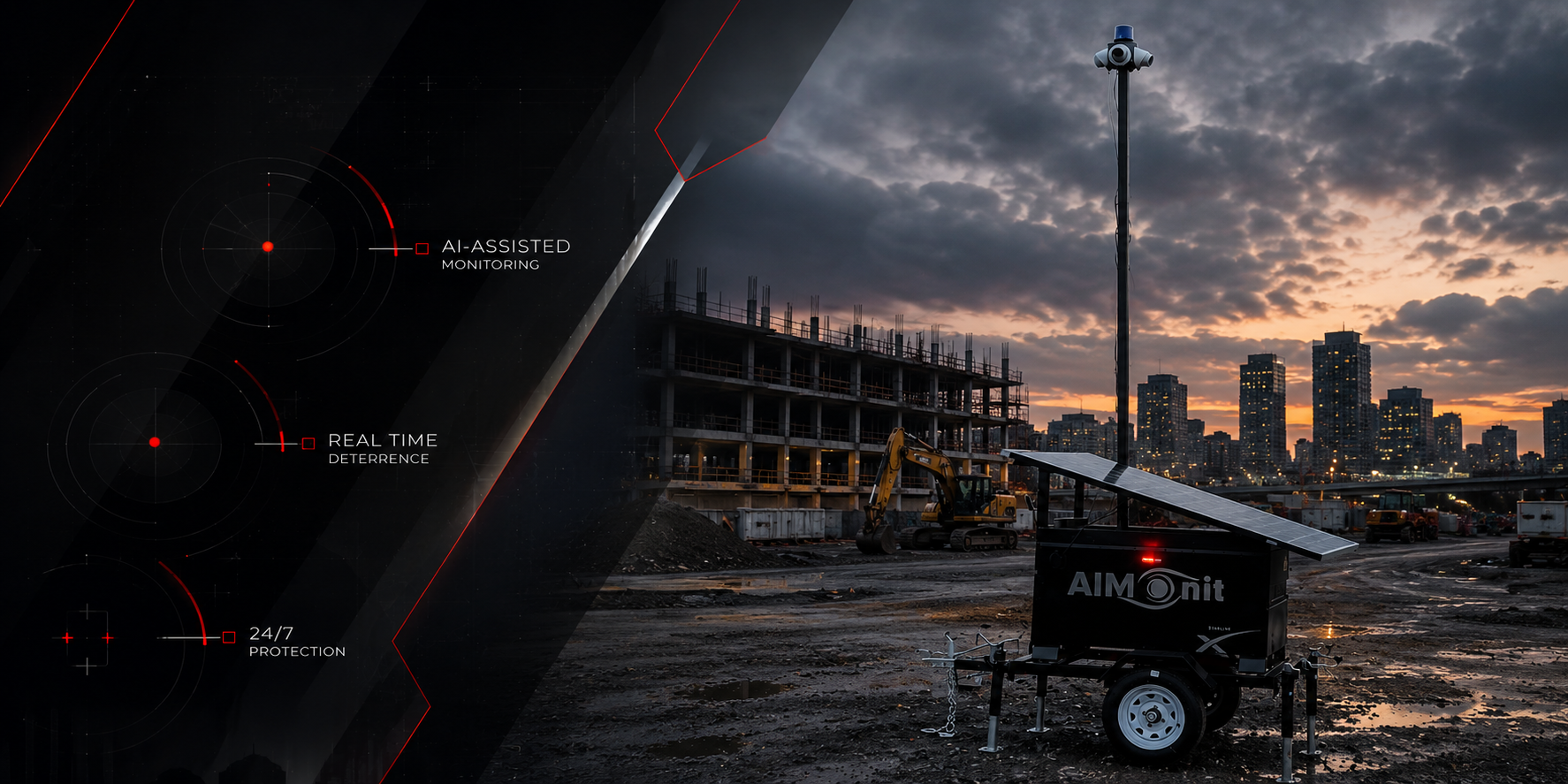
Modern monitoring doesn’t hang your entire security on who clocked in tonight. It runs the same way every night: 24/7 visibility across the site, real-time alerts when something moves, and the same action and response applied shift after shift. It also gives you proof. Every minute of your site is recorded and time-stamped, so after an incident the conversation moves from “we think the guard was there” to “here is exactly what happened and when.” That difference matters when you’re dealing with theft, liability, or an insurance claim.
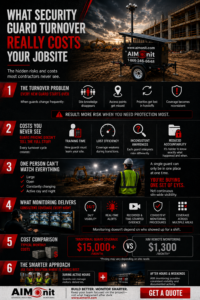
Then there’s the actual hard costs. Comprehensive guard coverage on a single site can easily run $15,000 a month. Monitoring from a company like Advanced Industrial Monitoring often runs around $1,300 a month for continuous coverage. That isn’t trimming the budget. It’s an order-of-magnitude difference that can change how a whole project pencils out. Not just protection but consistency with video backup of all activity day and night.
The smartest setup is usually both
For a lot of projects the real answer isn’t choosing a guard over monitoring. It’s using each option where it protects you the best. Keep guards on during active hours, when crews, deliveries, and visitors are moving on and off site and a human presence can verify access. Let monitoring carry the after-hours, the weekends, and the corners that are hard to patrol consistently. This is exactly where turnover and fatigue with live guards cause the most damage. You end up with stronger coverage and a lower total bill at the same time. Security isn’t just having a body on site. It’s knowing your coverage is consistent and documented. This keeps your team focused on building instead of wondering what happened after dark, which also helps keep the whole project on schedule.
AIM serves job sites across the entire East Coast of the US and the Caribbean, including New York, New Jersey, Pennsylvania, Delaware, Maryland, Washington, D.C., West Virginia, Virginia, North Carolina, South Carolina, Georgia, Tennessee, and Puerto Rico.
Get in touch with Advanced Industrial Monitoring for a quick demo, and we’ll show you what consistent coverage looks like for your site and your budget.
For our services in the Midwest and West Coast, please visit our sister company Jobsite Sentry at jobsitesentry.com.
FAQ
How much does jobsite monitoring cost compared to security guards? Comprehensive guard coverage on a single site can run $15,000 or more a month. Monitoring from Advanced Industrial Monitoring often runs around $1,300 a month for continuous coverage, an order-of-magnitude difference.
Why is guard turnover a problem for jobsite security? High turnover means the guard protecting your site changes often, and very few build real familiarity with the layout. That creates gaps, inconsistent enforcement, and blind spots that never show up on the invoice.
Can monitoring replace security guards entirely? Many times yes, but some sites do well with a blend: guards during active hours when people are moving on and off site, and monitoring after hours, on weekends, and in areas that are hard to patrol.
Is monitoring footage usable for insurance or liability? Yes. Activity is recorded and time-stamped, so you can show exactly what happened and when, which greatly helps in theft, liability, and insurance discussions. We regularly provide footage to police and investigators.